Academic project

2023

Airbnb: Understanding how young adults plan and book travel

Exploring travel behaviors to uncover opportunities for a better booking experience.
Role

UX Research, PM

Timeline

08/2023 - 12/2023

Methods

Usability Tests, Surveys, Contextual Inquiry, Interviews

Team

3 Researchers

Role

UX Research, PM

Timeline

08/2023 - 12/2023

Methods

Usability Tests, Surveys, Contextual Inquiry, Interviews

Team

3 Researchers

Overview

Understanding the barriers between browsing and booking

This course-based UX research project examined the travel booking habits and decision-making processes of young adults to help convert Airbnb website visitors under 35 into paying customers.

Using a mixed-methods approach, our team identified usability barriers and decision-making factors that affect booking behavior on Airbnbโ€™s desktop site, yielding in actionable recommendations aimed at increasing engagement for young adult users.

Context

A new generation is reshaping how travel is planned and booked

~5

Average trips taken by young adults in 2023

~5

Average trips taken by young adults in 2023

McKinsey (2023)

5+ hrs

Hours consuming travel content before booking

5+ hrs

Hours consuming travel content before booking

Expedia Group (2023)

80%

Of travelers used an OTA during their booking journey

80%

Of travelers used an OTA during their booking journey

Expedia Group (2023)

Young adults are reshaping the travel landscapeโ€”not only through how often they travel, but also through how they plan. Their booking journeys span multiple digital touchpoints as they browse, compare, and evaluate options before buying.

For Airbnb, understanding these behaviors presents an opportunity to identify what drives young adults from browsing to booking.

Problem

Browsing doesnโ€™t always lead to booking

For this course-based project, our team explored the browsing-to-booking journey for young adults using Airbnbโ€™s desktop platform.

While many young adults visit travel websites to explore lodging options, they book far less often than they browse. Young travelers browsing Airbnb struggle to confidently choose a listing due to overwhelming options and unclear differences between stays, leading to decision fatigue and delayed or abandoned bookings.

Our research centered on one question:

The Challenge

How might we help young adults move from browsing to booking on Airbnb with greater confidence?

How might we help young adults move from browsing to booking on Airbnb with greater confidence?

Methodology

Building insights through a layered research approach

Our team conducted recruitment screeners, contextual inquiries, interviews, usability testing, surveys, affinity mapping, and data analysisโ€”in that orderโ€”to generate actionable insights.

By sequencing our methods this way, we were able to intentionally build findings on top of one another, allowing each phase to inform and strengthen the next.

Recruitment Screener

Finding the right participants

We selected participants under 35 years old who either traveled recently or planned to travel within the next three months to ensure that our key findings were derived from our targeted demographic.

Who we recruited

Age

Under 35 years old

Device

Uses desktop for booking

Airbnb Experience

Has previously used Airbnb

Recent Website Use

Used a travel website within the past year

Future Website Use

Plans to use a travel website in the future

Travel Activity

Traveled within the past 3 months OR plans to travel within the next 3 months

Age

Under 35 years old

Device

Uses desktop for booking

Airbnb Experience

Has previously used Airbnb

Recent Website Use

Used a travel website within the past year

Future Website Use

Plans to use a travel website in the future

Travel Activity

Traveled within the past 3 months OR plans to travel within the next 3 months

Contextual Inquiry

Understanding how young adults actually plan and book travel

To understand how young adults approach travel planning and accommodation decisions, our team conducted contextual inquiries using an interview guide I created.

We explored participantsโ€™ experiences and priorities through semi-structured interviews, then observed how they searched for accommodationsโ€”asking probing questions to uncover the workflows, behaviors, and decisions shaping their process.
What we learned

01 โ€” AFFORDABILITY

Price set the boundaries; everything else became a tradeoff.

Price set the boundaries; everything else became a tradeoff.

Participants prioritized affordability first, then balanced location, safety, reviews, amenities, and group needs.

Participants prioritized affordability first, then balanced location, safety, reviews, amenities, and group needs.

โ€œI have a limited budget and Iโ€™d rather spend it on random things than an expensive hotel.โ€

02 โ€” CONTEXT

The โ€œrightโ€ lodging depended on the trip.

The โ€œrightโ€ lodging depended on the trip.

There was no universal โ€œbestโ€ type of lodging. Destination, party size, budget, transportation, and trip purpose shaped what participants considered the right fit.

There was no universal โ€œbestโ€ type of lodging. Destination, party size, budget, transportation, and trip purpose shaped what participants considered the right fit.

โ€œIt just depends on the situation.โ€

03 โ€” TRANSPORTATION

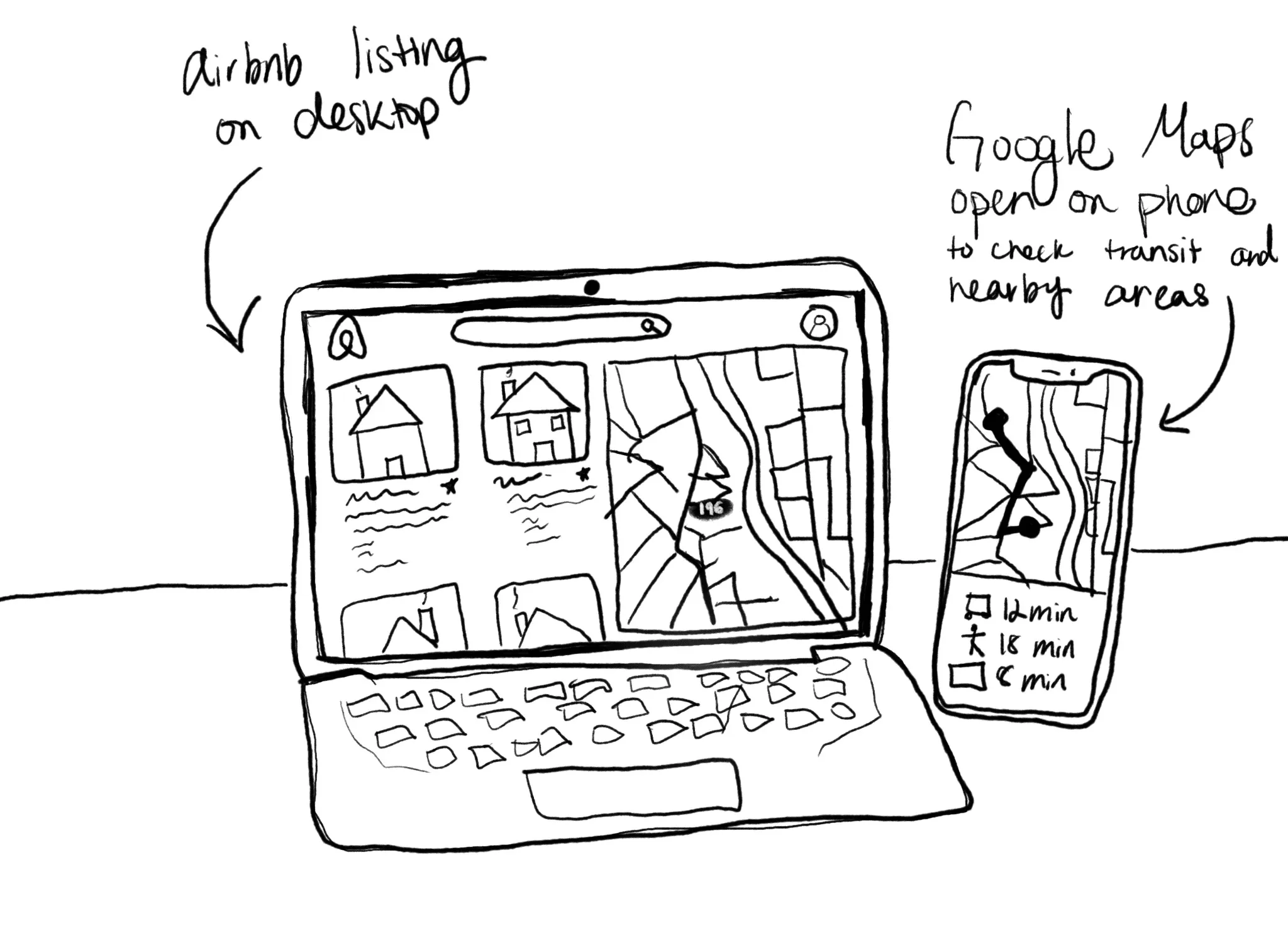
Travelers left Airbnb to understand what was around a listing.

Travelers left Airbnb to understand what was around a listing.

Participants used external tools such as Google Maps to evaluate transit, walking routes, and nearby destinations.

Participants used external tools such as Google Maps to evaluate transit, walking routes, and nearby destinations.

โ€œI would pull up Google Maps in another window to check walking routes.โ€

04 โ€” SAFETY

Safety was personalโ€”and difficult to judge from a listing.

Safety was personalโ€”and difficult to judge from a listing.

Participants relied on multiple signalsโ€”including photos, reviews, location, lighting, and neighborhood contextโ€”to determine whether a stay felt safe.

Participants relied on multiple signalsโ€”including photos, reviews, location, lighting, and neighborhood contextโ€”to determine whether a stay felt safe.

โ€œSafety means different things for people.โ€

From there, we wanted to build on what we learned by evaluating the usability of Airbnbโ€™s website.

Usability Testing

Evaluating how Airbnb supports the lodging journey

Building on our contextual inquiry findings, we evaluated how well Airbnb supported participants as they searched for lodging and explored other features.

3 Participants

3 Participants

3 Participants

Moderated

Moderated

Moderated

Desktop

Desktop

Desktop

2 Core Tasks

2 Core Tasks

2 Core Tasks

01 โ€” LODGING SEARCH

Find an Airbnb that fits the requirements

Participants searched for a stay near a train station in New York City for a January trip with a friend.

What we observed

Participants relied heavily on the map feature due to lack of relevant filters, attempting to zoom in to locate icons of transit hubs and key landmarks relative to candidate listings.

Usability Gap

Lack of relevant filters and map interactivity failed to surface relevant data, making it difficult for participants to find suitable accommodations.

01 โ€” LODGING SEARCH

Find an Airbnb that fits the requirements

Participants searched for a stay near a train station in New York City for a January trip with a friend.

Usability Gap

Lack of relevant filters and map interactivity failed to surface relevant data, making it difficult for participants to find suitable accommodations.

blah

What we observed

Participants relied heavily on the map feature due to lack of relevant filters, attempting to zoom in to locate icons of transit hubs and key landmarks relative to candidate listings.

02 โ€” EXPERIENCES

Find a photography-related activity in New York City

Participants explored Airbnb Experiences to find an activity where they could take photos during their trip.

What we observed

Participants were relatively unfamiliar with the Experiences section and had mixed expectations about what it offered. Some struggled to find the section at all.

Usability Gap

Experiences lacked clear discoverability. Some participants struggled to find the section, while others were unsure what to expect once they got there.

02 โ€” EXPERIENCES

Find a photography-related activity in New York City

Participants explored Airbnb Experiences to find an activity where they could take photos during their trip.

Usability Gap

Experiences lacked clear discoverability. Some participants struggled to find the section, while others were unsure what to expect once they got there.

What we observed

Participants were relatively unfamiliar with the Experiences section and had mixed expectations about what it offered. Some struggled to find the section at all.

02 โ€” EXPERIENCES

Find a photography-related activity in New York City

Participants explored Airbnb Experiences to find an activity where they could take photos during their trip.

Usability Gap

Experiences lacked clear discoverability. Some participants struggled to find the section, while others were unsure what to expect once they got there.

blah

What we observed

Participants were relatively unfamiliar with the Experiences section and had mixed expectations about what it offered. Some struggled to find the section at all.

01 โ€” LODGING SEARCH

Find an Airbnb that fits the requirements

Participants searched for a stay near a train station in New York City for a January trip with a friend.

Usability Gap

Lack of relevant filters and map interactivity failed to surface relevant data, making it difficult for participants to find suitable accommodations.

What we observed

Participants relied heavily on the map feature due to lack of relevant filters, attempting to zoom in to locate icons of transit hubs and key landmarks relative to candidate listings.

Survey

Understanding the broader travel landscape

To complement our qualitative research, we used a survey to capture broader patterns in how people plan travel and the platforms they use.

While contextual inquiries and usability tests provided in-depth insights into pain points and user behaviors, the quantitative data allowed us to complement these insights with measurable evidence.

Synthesis

Turning observations into patterns

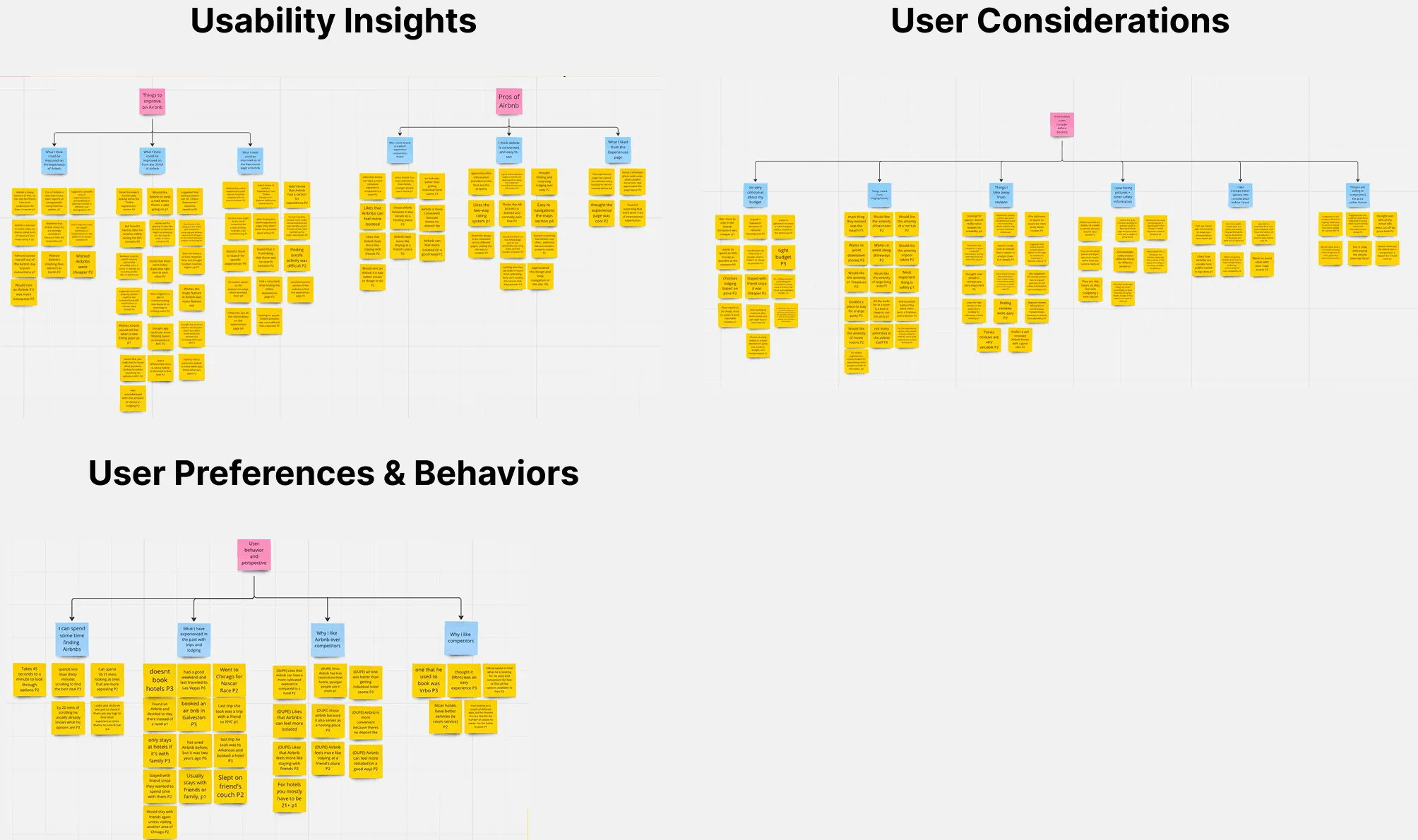
We synthesized findings across our contextual inquiries, usability tests, and survey, grouping recurring observations into three themes: user considerations, preferences & behaviors, and usability insights.
Key Findings & Recommendations

From research insights to design opportunities

01 โ€” VALUE & AFFORDABILITY

Price shaped nearly every lodging decision.

Participants balanced price against location, amenities, and other needs.

"I would rather book a 7/10 that's missing things than a 10/10 that costs a lot more."

Recommendations

Surface high-value stays

Make costs and tradeoffs easier to compare

02 โ€” EXPERIENCE & CONTEXT

The "right" lodging depended on the trip.

Party size, destination, budget, and trip purpose shaped whether participants preferred Airbnb, hotels, staying with friends, or other options.

โ€œAirbnb has a more cultivated experience compared to a hotel. It feels like staying with a friend.โ€

Recommendations

Highlight unique stays and social spaces

Organize recommendations around trip context

03 โ€” PLATFORM USABILITY

Key information and features were difficult to find within Airbnb.

Participants relied on external tools such as Google Maps to understand transportation, while some struggled to discover Airbnb Experiences.

โ€œThe Experiences page was a hunt to find.โ€

Recommendations

Integrate transportation and proximity information

Make Experiences more prominent and searchable

01 โ€” VALUE & AFFORDABILITY

Price shaped nearly every lodging decision.

Participants balanced price against location, amenities, and other needs.

Recommendation

Surface high-value stays

Make costs and tradeoffs easier to compare

"I would rather book a 7/10 that's missing things than a 10/10 that costs a lot more."

01 โ€” VALUE & AFFORDABILITY

Price shaped nearly every lodging decision.

Participants balanced price against location, amenities, and other needs.

"I would rather book a 7/10 that's missing things than a 10/10 that costs a lot more."

Recommendations

Surface high-value stays

Make costs and tradeoffs easier to compare

Impact

Seeing our recommendation reflected in Airbnb

In 2023, our research identified the discoverability of Airbnb Experiences as a usability gap and recommended giving the feature greater prominence. Airbnb later introduced a similar navigation change, moving Experiences into its primary navigation. While our work was not connected to Airbnb's product team, the change reinforced the relevance of the usability issue we identified.

Learnings

Taking these lessons forward

Follow the participant, not the script.

I learned to probe deeper during semi-structured interviews and follow participantsโ€™ lines of thinking when unexpected insights emerged.

Follow the participant, not the script.

I learned to probe deeper during semi-structured interviews and follow participantsโ€™ lines of thinking when unexpected insights emerged.

Create structure that helps the team succeed.

As project manager, I coordinated schedules and kept deliverables ahead of deadlines, creating time for feedback, iteration, and stronger collaboration.

Create structure that helps the team succeed.

As project manager, I coordinated schedules and kept deliverables ahead of deadlines, creating time for feedback, iteration, and stronger collaboration.

Let each research phase inform the next.

Sequencing our methods intentionally allowed insights from one phase to shape the next, helping us progressively deepen our understanding of participants.

Let each research phase inform the next.

Sequencing our methods intentionally allowed insights from one phase to shape the next, helping us progressively deepen our understanding of participants.